Groupthink doesn’t live here, critical thought does.
Welcome!
This ad-free website is dedicated to Agnès Varda and to Luis Buñuel.
Get cool rewards when you click on the button to pledge your support through .
Thanks a lot acorns!
Your kind generosity keeps the reviews coming!
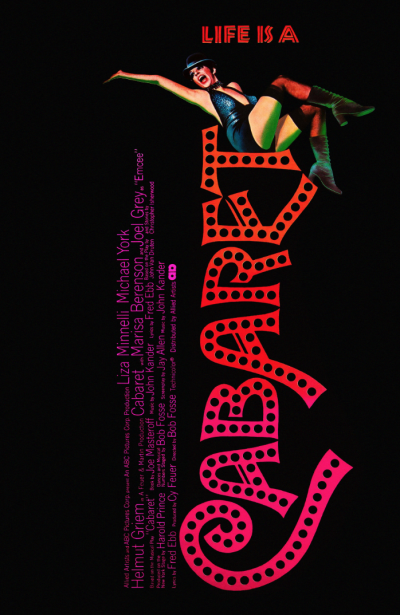 Bob Fosse won a much-deserved Oscar for his uniquely constructed adaptation of a successful musical drama set during Germany’s brutal shift towards Nazism in the early ‘30s. Weimar Republic era Berlin witnesses Brown Shirt-inflicted violence in the streets. Racism rules.
On-location filming in Germany contributes to the film’s visual sense of historic realism. Mixed crowds of locals, military officers, diplomats, and tourists congregate in the audience of the Kit Kat Klub, a seedy little nightclub of debauched delights lorded over by Joel Grey’s wiry enigmatic master-of-ceremonies. The opening number (“Willkommen”) is a showstopper of exotic style and musical delivery. Welcome to the cabaret.
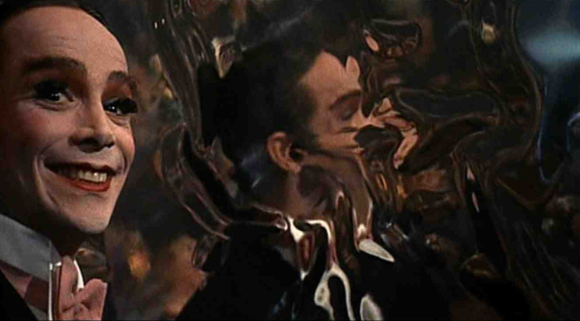
The bawdy burlesque stage-show is ribald social theater with smart doses of corrective criticism, however cleverly concealed by an all-woman jazz band dressed in underwear and corsets, and a repertoire of innuendo-laced jokes and songs from their grandiloquent emcee.
“If You Could See Her” is an especially incisive number that Grey’s naughty everyman character sings about regarding a German man in love with a Jewish woman.
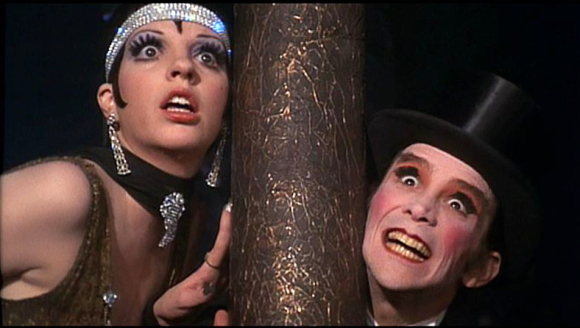
Sally Bowles (Liza Minnelli) is a sexually ravenous cabaret singer with a great voice, hot dance moves, and a sexy pixie-hair-cut. She wears green nail polish. However clad in masculine costumes, androgynous — the sultry Sally Bowles is not. Her probable bi-sexuality is another matter.

Fosse subverts the play’s common musical form. He removes the artifice of characters breaking into song. With only two nuanced exceptions, all of the film’s songs occur in the live-performance space of the story’s emblematic nightclub location. Fosse juxtaposes a formal proscenium camera approach during the musical sequences, with precise editing, to give the viewer an intimate theatrical experience inside the cabaret. The story, however, takes place outside where a political and economic tidal wave is crashing.
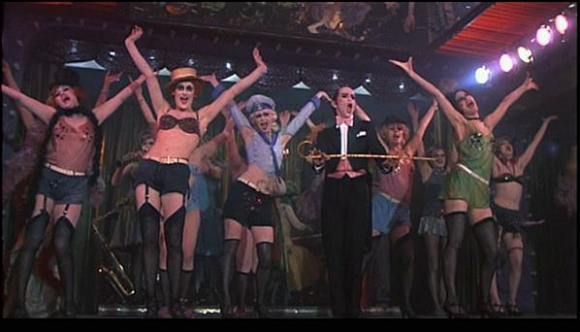
Fosse’s dazzling choreography is steadily on display. Every leg move or facial expression is provocative. Fosse’s cultured artistic vision inspires otherworldly performances from his actors. The ensemble work from Liza Minnelli and Joel Grey — in roles they were seemingly born to play — convey a cynical and rebellious attitude of free expression that gives pre-war German audiences and performers an intimate form of escapism entertainment — nudity included of course.
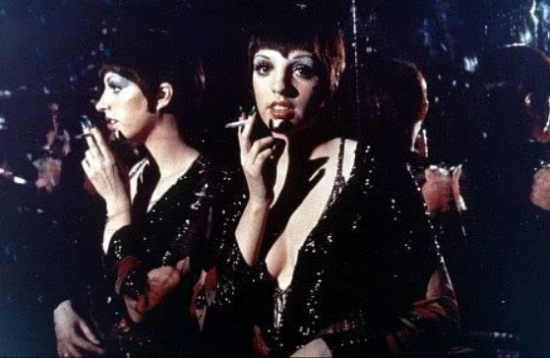
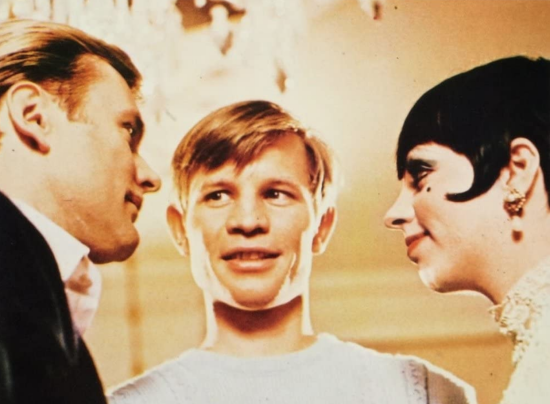
British ex-pat English instructor Brian Roberts (Michael York) moves into to the same boarding house with Sally. Hot blushes of romance flicker between them but Brian doesn’t play for Sally’s team, well not at first anyway. Brian’s bi-sexuality carries the film’s main subplot regarding his romantic relationship with Sally after the entrance of Max, a playboy baron who swings both ways between Sally and Brian while the world around them collapses.
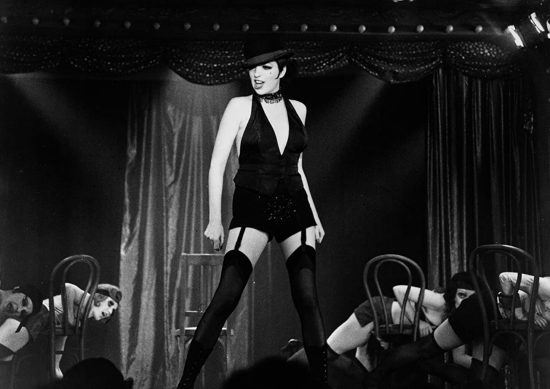
“Cabaret” gives the magnificent songs of John Kander and Fred Ebb the proper regard they deserve in the narrative context of Jay Presson Allen’s economical script. Fosse elevates the music with exquisite song and dance performances. The purposefully compartmentalized subplot serves as Greek Chorus of novelistic information.
Bob Fosse is the only director in history to ever win a Tony, an Emmy, and an Oscar, all in the same year. In 1972 Bob Fosse won a Tony for his Broadway production of “Pippin.” He won an Emmy for his television special “Liza with a Z.”