Welcome!
Groupthink doesn’t live here, critical thought does.
This ad-free website is dedicated to Agnès Varda and to Luis Buñuel.Punk heart still beating.
Get cool rewards when you click on the button to pledge your support through .
Thanks a lot acorns!
Your kind generosity keeps the reviews coming!
 Howard Hawks’s “Bringing Up Baby” is the go-to example of screwball comedy that critics and film-lovers reference most as the definitive model of the genre. The picture exemplifies the category’s requisites of farce, innuendo, punchy dialogue, comic anticipation, and pratfalls.
The slapstick-punctuated comedy revolves around Cary Grant’s engaged-to-be-married paleontologist David Huxley, and Katherine Hepburn’s Susan Vance, a high-society tornado of trouble with romantic eyes for David.
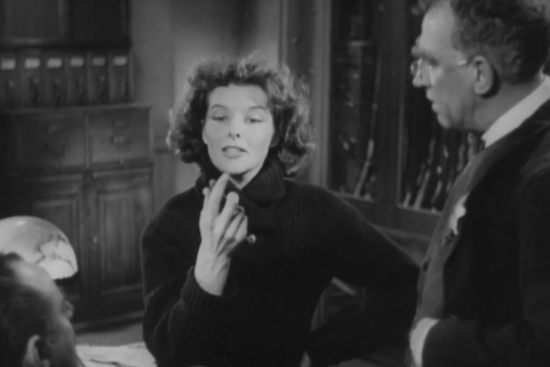
The screenwriters emphasize David’s incompatibility with his also-bespectacled fiancée Alice Swallow (Virginia Walker) in the film’s opening scenes when she makes it clear that there will be no hanky-panky even after the wedding. Alice is staking out her dominance in the relationship. Alice may be a great assistant in the lab, but she clearly isn’t wife material.
Toss in a tame leopard named Baby, a missing Brontosarus bone (the “intercostal clavicle” to be exact), and several people connected to Mr. Peabody, a wealthy would-be donor of a million dollars to give David for his scientific research, and let the laughs fly.

Hawks sets the script’s frequently overlapping dialogue at an unprecedentedly (at the time) quick tempo that Grant and Hepburn zip though with their distinctly idiosyncratic voices. Hepburn’s New England accent filters through her raspy, not quite obnoxious, voice in harmony with Grant’s trademark staccato delivery of unlikely octave leaps.

Romantic tension pops between Hepburn and Grant because their characters are so steadfastly at odds and yet helplessly caring for one another in spite of the waterfall of calamities that strike whenever they are together. Their funny compatibility is best revealed through the conflicts that beset them.
The couple’s introductory meeting, on a golf course, involves Susan playing one of David’s balls (she sinks the putt), before inexplicably pretending that his convertible belongs to her. David’s oversized auto suffers some severe dents before he is compelled to ride on the running board as she drives the aim of her starry-eyed intentions away from Mr. Peabody.

Although modern audiences don’t pick up on it the way Depression Era spectators did at the time, an essential “screwball comedy” conceit lies in David’s and Susan’s upper class status. Nerdy David works for a museum, while independent Susan is a headstrong but ditzy bon vivant. Both are financially secure people who dare not look their attraction in the eye. When Susan disposes of David’s clothes after he takes an unintentional dip, he is forced to put on her oh-so-frilly nightgown. A comic zinger arrives when David is forced to explain his controversial mode of dress to Susan’s aunt Elizabeth (May Robson). David says, “Because I just went gay all of sudden!” Cary Grant leaps into the air while spilling the line as if the floor has suddenly become too hot to stand on.
The leopard serves as a great comic randomizer for the preposterous plot to spin out of control. Susan knows that singing the 1928 standard “I Can’t Give You Anything But Love, Baby” calms Baby down. Listening to Grant and Hepburn harmonize together on the song is comically painful in a delightful way. Hitting the notes isn’t as important as the screwball route they seem to take along the way.
Not Rated. 102 mins.