Groupthink doesn’t live here, critical thought does.
Welcome!
This ad-free website is dedicated to Agnès Varda and to Luis Buñuel.
Get cool rewards when you click on the button to pledge your support through .
Thanks a lot acorns!
Your kind generosity keeps the reviews coming!
 A majestic political and artistic triumph, and one of the finest films of all time, “1900” (made in 1976) is Bernardo Bertolucci’s crowning achievement and the benchmark of collectivist socio-political cinema.
Set on a grand scale, and formally composed, this Italian drama is about a community of peasant farmers spanning the period between the turn-of-the-century Belle Epoque and the end of World War II, as seen through the eyes of two socially opposed boys. That this internationally cast epic was made possible because of the success of Bertolucci’s controversial “Last Tango In Paris” (1972) contributes to the mystique of “1900.”
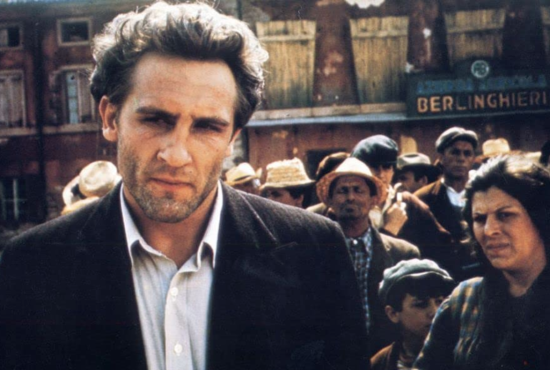
The 35-year-old director’s newfound status as both a commercially viable and visionary filmmaker allowed his imagination to run free, at the height of his powers, to complete his trilogy of films about Italian Fascism with an original script co-written with his brother Giuseppe and Franco Arcalli (both were co-screenwriters with Bertolucci on “Last Tango”).
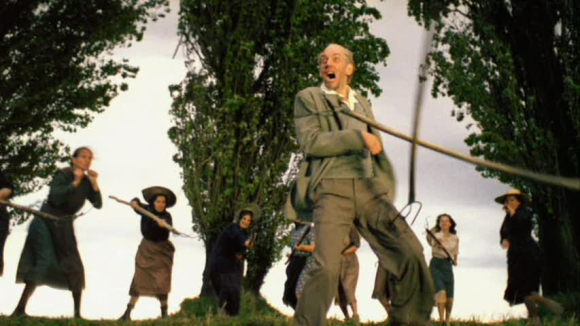
Whereas the first two films in the trilogy (“The Spider’s Stratagem” – 1970 and “The Conformist” – 1971) exist in a stylish bourgeois noir world of cloaked deceit, “1900” explores a vibrant ancestral identity shared by a group of socialist farmers, the landowners for whom they work, and fascist factions penetrating rural Parma, Italy. The film’s half-century scope provides a macro/micro slant on psychological, generational, political, and cultural changes in the region of Bertolucci’s birth. Following the contained, and at times claustrophobic, expressionist style of “Last Tango,” “1900” is a 180-degree turn into a wide-open direction.
For his thirteenth film Bertolucci wanted to express what he saw as Italy’s transition from a “multi-culture” society to a “mono-culture” due to the influence of the industrial revolution — and capitalism more precisely. The thick-layered chronicle doesn’t sweep across time so much as it escorts the audience through indelible composite events viewed through the prisms of personal, social, and political narratives. Luchino Visconti‘s influence — as well as that of Bertolucci’s favorite director Jean Renoir — arouses “1900’s” authentic sense of time, place, and attitudes of the period. Bertolucci mentions following Renoir’s advice to “always leave a door open on the set, to allow reality to enter into the film.” The result is a defiant naturalism and erotic candidness that colors the film with bursts of shockingly raw emotional energy.
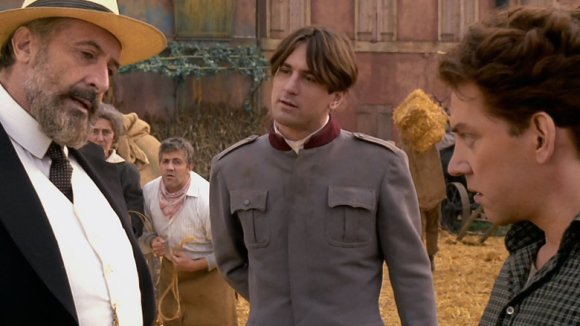
Bertolucci’s usual cinematographer Vittorio Storaro (“Last Tango”) captures a dazzling color palate for a distinctly idealistic vision in “1900,” which runs from Van Gogh-inspired hues of golden hay to cold gothic grays that follow the story from spring through winter — from youth to old age, from hope to postwar collapse.
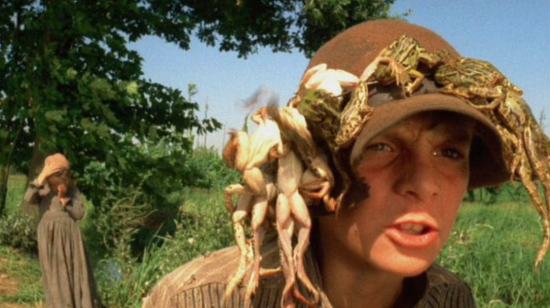
The film’s Italian title “Novecento” (“Twentieth Century”) clarifies better than its American designation Bertolucci’s intent to depict the first half of the 20th century through a utopian vision of poor communitarian farmers living and working on an expansive country vineyard estate for their patriarchal padroné masters. We follow the trajectories of Olmo and Alfredo, born on the same day from opposite social classes. Three generations of historic experience depict rural life in Italy from peace to fascism to war.

As “1900’s” iconic deco-themed red-and-black poster implies, the story is a complex study of social decay under the world’s longest experiment with fascism, the 22 year long regime of Benito Mussolini. In spite of what some critics saw as a failed leftist screed, Bertolucci had no illusions regarding the potential for “1900,” or any movie for that matter, to effect social change.
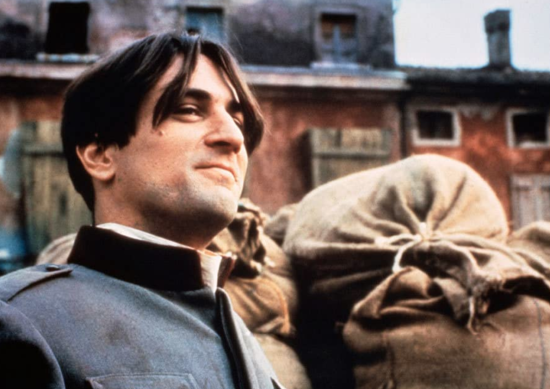
For as passionate as Bertolucci’s depiction of the peasant struggle is, he remains surprisingly ambiguous in representing matter-of-fact narrative threads that defy misinterpretation. For the sprawling amount of time the story covers, “1900” achieves an escalating, concussive dramatic punch through Bertolucci’s magnificent use of montage to create scenes of a fictional history — as translated from stories shared by local farmers in Parma, Italy.