Groupthink doesn’t live here, critical thought does.
Welcome!
This ad-free website is dedicated to Agnès Varda and to Luis Buñuel.
Get cool rewards when you click on the button to pledge your support through .
Thanks a lot acorns!
Your kind generosity keeps the reviews coming!
Indisputably the greatest musical ever made, “West Side Story” (1961) has sadly proven socially timeless regarding America’s eternally troubled immigrant experience.
After becoming a Broadway hit in 1957, and winning over London theater audiences in 1958, it was inevitable that “West Side Story” would get the big-budget Hollywood film treatment. Leonard Bernstein’s powerful orchestral music swells under Stephen Sondheim’s impeccable narrative-driving lyrics in order to transform Arthur Laruents’s “Romeo and Juliet”-inspired tale of doomed love on Manhattan’s city streets into a film that transcends the musical genre.
A haunting line graphic dares the viewer to guess at its oddly familiar design while the film’s opening medley plays for several minutes. Color light filters switch with changes in tempo.
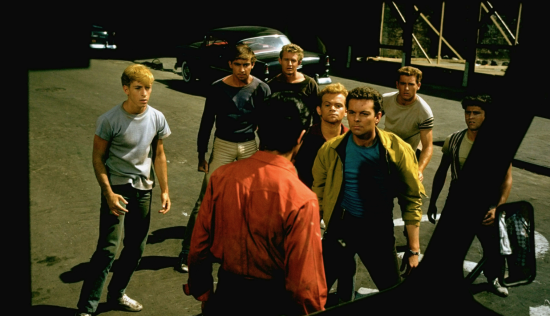
When the outline eventually transitions into a north-facing aerial view of ’60s era Manhattan, the effect is surprising for the modern setting that appears. The bird’s-eye vantage point settles on an Upper West Side neighborhood ruled by a gang of white hoodlums called the Jets. A rival gang of Puerto Rican boys who call themselves the Sharks pose an imagined threat.

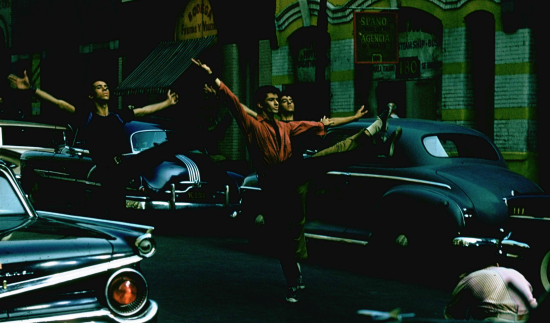
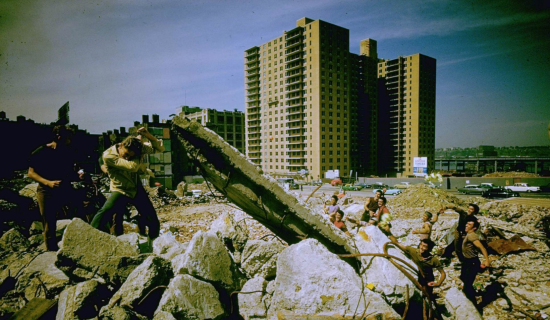
It’s a time when every skinny urban teen male dresses like James Dean’s character in “Rebel Without a Cause.” The spot-on casting of triple-threat actors whose brilliant execution of Jerome Robbins’s modern dance moves sweeps you up into the stylized action filmed on actual New York City streets. The actual area underwent a radical urban renewal project for Lincoln Center that wiped away all evidence of the battleground where the story takes place.
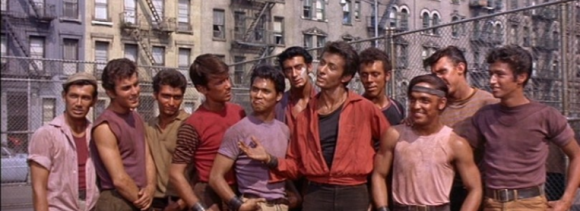
Russ Tamblyn’s charismatic Riff leads the Jets though Richard Beymeymer’s Tony is the gang’s aging governor. Tony has romance on the brain when the rival gangs attend a Saturday night dance where Natalie Woods’s Puerto Rican Maria is in attendance. Love-at-first-sight puts Maria and Tony on cloud nine. Naturally, Maria is sister to the Sharks leader Bernardo (George Chakiris). Just as the young lovers dream of a future together, the Sharks and the Jets are planning a rumble.
“West Side Story’s” magnificent blend of modern dance and Caribbean music, with Shakespearian underpinnings, provides an ideal platform for its dynamic dancing actors to shine. Natalie Wood singing with a Puerto Rican accent is every bit as captivating as Rita Moreno’s feisty mambo dance moves as Maria’s sister Anita. Although Jerome Robbins was pulled off the film in order for Robert Wise to take over directing duties, Robbins’s choreography is stunning. The film’s Technicolor treatment delivers a richness of color and depth of image that thrills.
As the winner of more Oscars than any other musical film, “West Side Story” is the standard that all others must be judged by.