Groupthink doesn’t live here, critical thought does.
Welcome!
This ad-free website is dedicated to Agnès Varda and to Luis Buñuel.
Get cool rewards when you click on the button to pledge your support through .
Thanks a lot acorns!
Your kind generosity keeps the reviews coming!
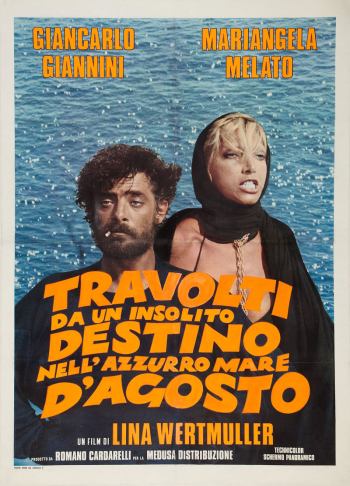
Lina Wertmüller’s inspired social satire is wrapped up in political titles, however false, that people identify with or use to paint others with as friend or foe.
Italian dogma of communist, fascist, and capitalist ideologies figure prominently into the upper and lower class characters that Wertmüller presents with a take-no-prisoners sense of irreverence and sexual frankness.
Four upper class couples are out for a day’s adventure on a yacht served by a macho crew whose pique of discontent about their disrespectful overlords comes through Giancarlo Giannini’s hangdog deck hand Gennarino Carunchio.
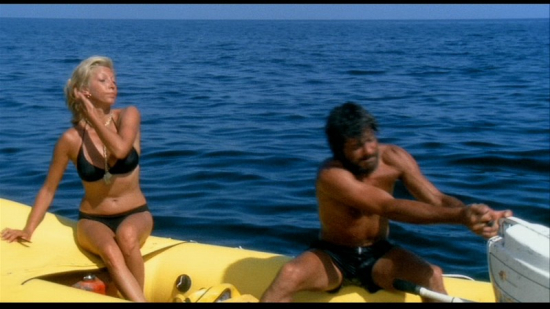
Gennarino is equal parts caricature and flesh. Giancarlo Giannini’s virtuosic performance borders on farce without ever crossing the line into exaggerated pantomime. It’s no wonder that Wertmüller relied on the gifted actor as a muse for other films such as “Seven Beauties” and “Love & Anarchy.”
Mariangela Melato’s rich snot Raffaella cares too much about the environment to be the capitalist devil that Gennarino pins her as. Still, she wears her entitlement on her sleeve. Mariangela slings insults and complaints at the boat crew she considers less than human. When the pasta isn’t cooked al dente she throws a fit befitting a three-year-old with a toothache. Sweaty t-shirts are also a bone of contention for Mariangela whose piercing green eyes closely resemble those of her sworn rival Gennarino.
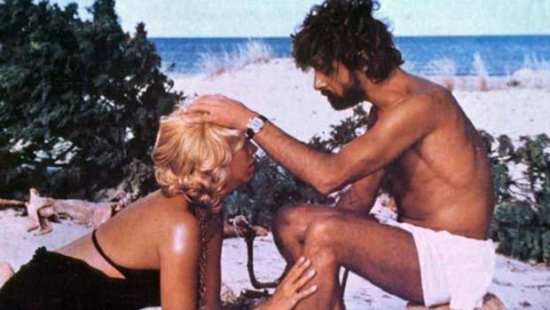
Tensions between Raffaella and Gennarino reach a primal equanimity after the two become stranded on a remote island where Gennarino proves his ability to provide food and shelter. Wertmüller’s satire pitches and peaks in Gennarino’s demanding process of taming Raffaella into his love slave.
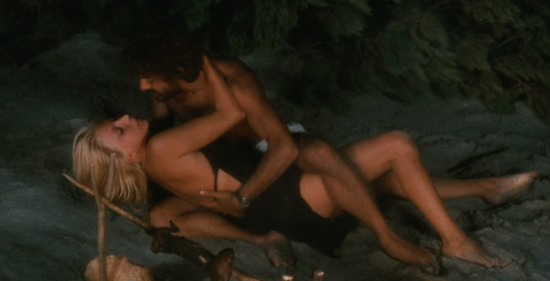
The roles of master and slave get reversed. Wertmüller’s forceful transfer of power between man and woman is as truthful and cunning as anything in the films of Catherine Breillat or Luis Buñuel. The scene where Raffaella demurely requests anal penetration is especially hilarious. Gennarino’s purposefully proletariat response speaks volumes.
“Swept Away” is as relevant today as it was when it was made. The power that lovers wield is as psychologically transient as any political ideology of the day, and just as predictable. It could well be the ultimate date movie for the intellectually and sensuously adventurous.