Groupthink doesn’t live here, critical thought does.
Welcome!
This ad-free website is dedicated to Agnès Varda and to Luis Buñuel.
Get cool rewards when you click on the button to pledge your support through .
Thanks a lot acorns!
Your kind generosity keeps the reviews coming!
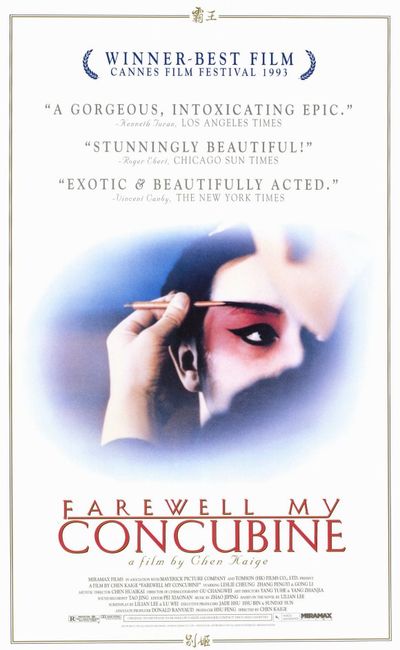 This lush epic period drama from director Kaige Chen encompasses over five decades of social and political cataclysms in China during the 20th century.
The generational shifts are projected through the experiences of two young Peking Opera performers whose lives become inextricably bound together as they become stars.
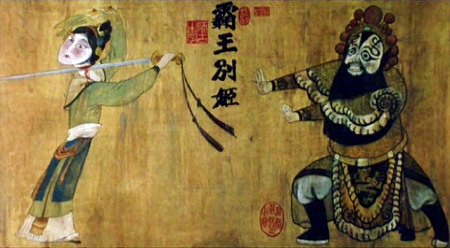
In the opera they play Cheng Dieyi and Duan Ziaolou, telling the beloved story of “Farewell, My Concubine,” about King of Chu’s lost battle to the Han king that leaves Chu with only the support of his loyal concubine, who sacrifices herself for her master.
The proposed moral of the story is that “each person is responsible for his or her own fate.” The nature of this idea resonates across the eras through which the story jumps.
Japan’s 1930’s invasion and occupation gives way to a Communist victory a decade later. The story opens in 1977 Beijing after the Cultural Revolution, the setting that bookends the story.
Beijing’s deadly Warlord Era (circa 1924) finds a young “Blossom House” prostitute (played by Jiang Wenli) severing her young son Douzi’s extra digit so he will be accepted into the Peking Opera as an actor-in-training. The Opera’s Master worries that boy’s extra finger “might have scared the audience.”

Filmic authenticity arrives as a delay occurs before the pain and blood registers in Douzi’s young mind. Screams follow. Master Guan’s training regiment for the boys is severe. Harsh punishments include regular beatings and body-stretching tortures. Child suicide also occurs within the walls of the remote training temple.
Douzi is assigned to play a girl opposite his friend Shitou. Douzi’s fraught indoctrination, into the female role, spikes when he repeatedly misspeaks a crucial line in the play he performs for a potential backer. Douzi reverses the phrase, “I am by nature a girl, not a boy,” to read that he is, “by nature a boy.” In truth Douzi is a gay boy attempting to come to grips with his sexuality.

These sub-text rich narrative details carry the audience through the dusty reality of China during each period of ideologically different but similar totalitarian regimes.
After becoming celebrated stars of the Peking Opera, Douzi and Shitou start to go in separate directions when Shitou (now called Duan) marries Juxian, a prostitute (masterfully played by screen legend Gong Li). In response Douzi (now called Cheng) shacks up with his gay sponsor Master Uuan (Ge You).

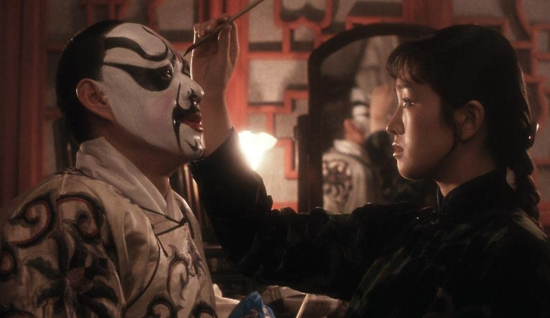
A ritual scene of the sexually incompatible opera actors putting on their make-up before a performance provides the setting for emotional fireworks to ignite. Their hazy dressing room can barely contain their “secret of success,” a dedication and loyalty designed by their Opera master to last for their lifetimes. They are connected more than either man could ever be with anyone else.
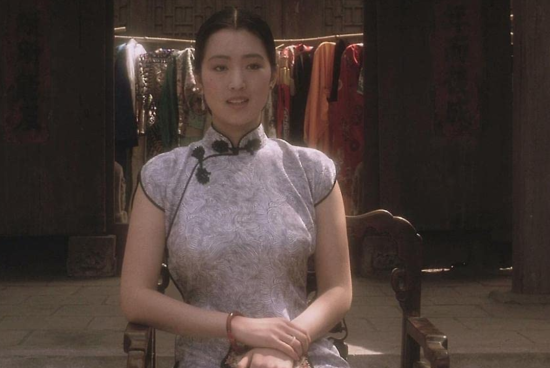
“Farewell My Concubine” utilizes traditional Chinese operas to give a musical and storytelling context for a love story between two men whose passion for their art transcends the choices they make in their personal and public lives outside of the theatre. Part history lesson, part love story, and part musical, here is a visually and thematically stunning epic from China that you will not forget.
Rated R. 171 mins.