Sean Penn Directs the Christopher McCandless Story
By Cole Smithey
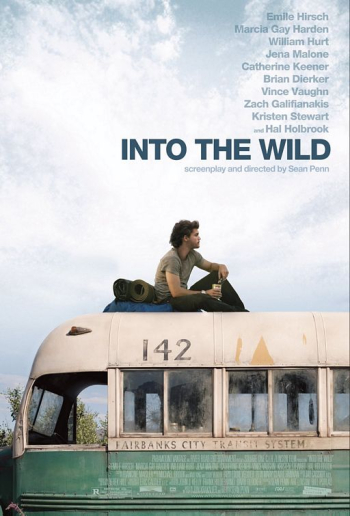 The enigmatic account of Christopher McCandless’s wilderness journeys, that Jon Krakauer eloquently brought to light in his best-selling 1996 book "Into the Wild," seems an oddly fitting subject for the fourth film of Sean Penn’s directing career behind "The Indian Runner," "The Crossing Guard" and "The Pledge." Penn wrote the screenplay, based on Krakauer’s book, and put Emile Hirsch ("Alpha Dog") into the role of the conflicted and fiercely idealistic young man who severed ties with his family in search of personal truths on a literary-fueled odyssey that ended near Alaska’s Denali National Park.
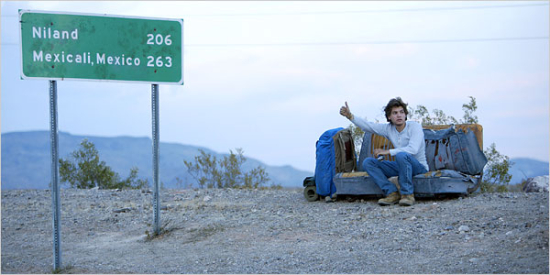
After graduating in 1990 with a double major in history and anthropology from Emory University in Atlanta, Chris McCandless gave away his college fund savings of $24,000 to a charity against hunger. He soon burned his cash and abandoned his old yellow Datsun after getting caught in a flash flood in Nevada. It was an act of quiet defiance against society emboldened by the works of Henry Thoreau, Nikolai Gogol, Jack London and Leo Tolstoy that would dispatch him through South Dakota, Oregon, California, Mexico, Arizona, Washington and Alaska over the next two and a half years.
Upon leaving high school, Chris made a fact-finding mission from his family’s middle class burb of Annandale, Virginia to the vicinity of El Segundo, California where he was born. There, he heard from past family friends about how his aerospace engineer father Walt McCandless had kept up relations with his first wife Marcia, even after taking up with Chris’ mother Billie. Walt secretly split his time between the two women long enough to sire a son (Quinn McCandless) from Marcia, two years after Chris was born. The dark revelation of his father’s base behavior instilled a silent burning rage in Chris that he would attempt to vanquish in the cold air of solitude as a method of passive resistance rather than openly confronting his father.
Some of Chris’s logic for his individual journey comes through in the quotes that he highlighted on the pages of the dog-eared paperbacks he carried with him. Jon Krakauer placed such excerpts among chapter headings of "Into the Wild" as a way of keeping the reader on course in a similar way that Chris McCandless must also have done, without the aid of a map of the region that could have saved his life.
Telling is a paragraph from Boris Pasternak’s "Doctor Zhivago," above which McCandless wrote, "Need For A Purpose."
"Everything had changed suddenly—the tone, the moral climate; you didn’t know what to think, whom to listen to. As if all your life you had been led by the hand like a small child and suddenly you were on your own, you had to learn to walk by yourself. There was no one around, neither family nor people whose judgement you respected. At such a time you felt the need of committing yourself to something absolute—life or truth or beauty—of being ruled by it in place of the man-made rules that had been discarded. You needed to surrender to some such ultimate purpose more fully, more unreservedly than you had ever done in the old familiar, peaceful days, in the old life that was now abolished and gone for good."

On April 28, 1992, Chris hiked 20 miles into the Alaskan wilderness along its Stampede Trail with a .22-caliber rifle, a 10-pound bag of rice, and a field guide to edible plants of the region called "Tanaina Plantlore." It was here that he came across the abandoned shell of a 1940’s International Harvester bus in which he would set up camp for the remaining 113 days of his life. During that time, Chris McCandless lived off the fat of the land, eating squirrel, porcupine, birds and a moose. But McCandless made a fatal error by eating the toxic seeds of wild potato roots that were not mentioned as poisonous in the book he referenced like a bible. Before succumbing in his sleeping bag within the shelter of the bus marked "Fairbanks City Transit System 142," Chris McCandless achieved his vision of a solitary primal existence necessarily based on a hunting and gathering lifestyle far removed from the mechanized bubble of the Western world.
Chris McCandless’ story divides people. On the surface, it seems another instance of a young unprepared adventurer with a thinly veiled suicidal fantasy who gets exactly what he bargained for. It is fraught with uncomfortable questions regarding the sins of the father, ambition, conformity, capitalism and freedom. But the layers of meaning, motivation and purpose surrounding his experience come through in the letters he wrote to people he befriended on the road and of their remembrances of their time spent with him. It’s this balance of connecting separately with people and nature that defines the limits of an allegory that Sean Penn has made for audiences to draw their own conclusions. You can bet that the polarizing director has made up his mind about the cultural significance of Christopher McCandless.

Get cool rewards when you click on the button to pledge your support through Patreon. Thanks a bunch pal!