Clint Eastwood Goes Above and Beyond the Call of Duty
“Letters” Responds to “Flags” and Creates Pure Cinematic Poetry
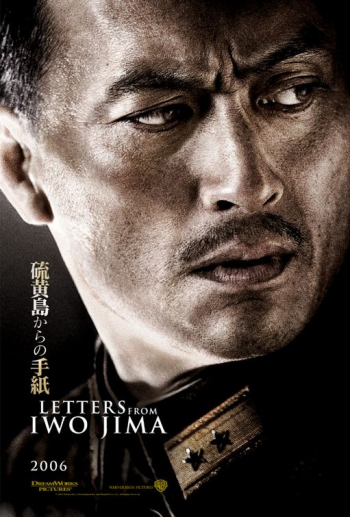 “Flags of Our Fathers” and “Letters From Iwo Jima” are opposite sides of the same currency Clint Eastwood uses to form an inseparable epic narrative correlating the deeply personal experiences of soldiers on both sides of the Japanese/American WWII conflict.
Nationalist ideologies and traditions are at stake. By putting “Letters” in Japanese with English subtitles, Eastwood maintains the reflexive energy of second-generation Japanese-American screenwriter Iris Yamashita’s convincing debut script.
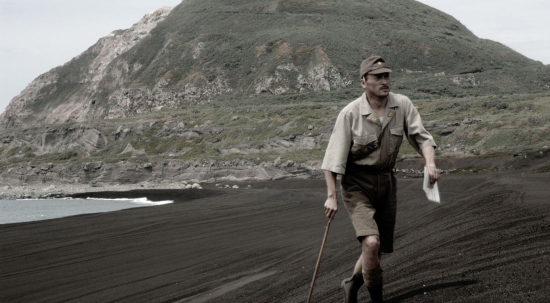
Yamashita uses a literary conceit that the story-within-the-story is informed by the discovery of a bag of letters buried on Iwo Jima by Japanese soldiers. The director’s personal inspiration for the film came from a book of letters (“Picture Letters From Commander In Chief”) written by General Tadamichi Kuribayashi to his family during the ‘20s and ‘30s when he lived in the U.S. serving as an envoy.
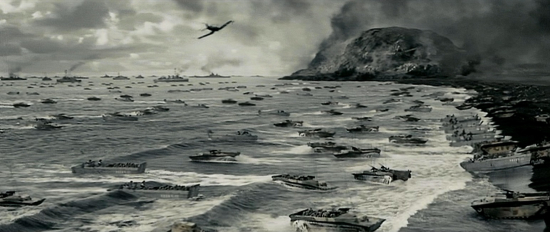
General Kuribayashi was later sent to take over command of battle preparations on the volcanic island of Iwo Jima where the Japanese government had sent their forces with the caveat that the soldiers would not leave. Eastwood has made the point that “this is not something you could tell an American [soldier] with a straight face.” The director emphasizes the attitudes and fears of the Japanese soldiers fighting against terrible odds for a death that will fulfill their duty.
Ken Watanabe (“Memoirs of a Geisha”) moors the story as General Tadamichi Kuribayashi whose generous empathy for his men and impromptu defense strategy transforms a predicted five-day battle into a 40-day clash. Watanabe is a master of poignancy.The aristocratic focus of his gaze supports the tremendous level of loyalty he inspires in his soldiers who dig more than 18 miles of tunnels, 5000 caves, and untold numbers of “pillbox” trenches in the island’s coal-black sand.

Visually, the movie seems darker even than the monochromatic blue/gray color design used in “Flags of Our Fathers.” The limited color palette has a hypnotic effect of drawing the viewer into the gloomy mindset of the same soldiers that we rooted against while watching “Flags.”
The moodiness of the visuals serves to restrain the potentially numbing effect of the often-traumatic violence onscreen. In one of Eastwood’s most effective usages of staging, a battalion of exhausted soldiers hide in a tunnel beneath the defeated ground of Mount Suribachi.

Sworn to defend the region to their deaths the soldiers begin, one by one, pulling the pins from their grenades and hitting the bomb against their helmets before blowing themselves up. It’s a surreal scene, and one that might prove unwatchable were it not for the desaturated color that lends a filter of distance from the sad reality of men joining in shared suicide. The episode is also significant for the two soldiers who refuse to take their own lives, choosing instead to return to their commander to continue fighting.

Saigo (Kazunari Ninomiya) dreams of returning to his life as a baker. He yearns to be with his wife and daughter, who was born after he was sent to war. Ninomiya’s character carries the film’s theme of hope. The talented young actor’s unvarnished performance has an innocent vitality that operates on a primal level of childhood innocence. He’s never self-pitying. As such, he gives the audience something to identify with beyond his conflicted sense of humanity and loss.
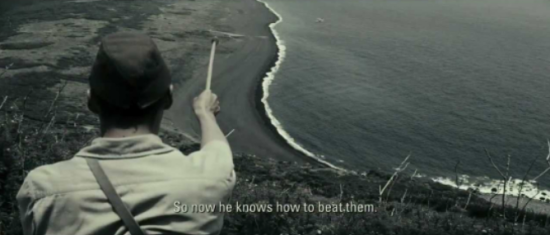
Clint Eastwood performed the year’s most ambitious and original cinematic feat in making a pair of companion films about the significance of the battle at Iwo Jima. The films are masterpieces of modern cinema, filled with filmic poetry of bright, medium, and dark images that express Eastwood’s talent as a director to work on a large-scale narrative canvas to effect a resonate exchange of ideas.
The two movies bridge a cultural divide to condemn all acts of war as futile expressions of political impotence, if not capitalist greed. Nearly 7000 American soldiers died along with the more than 20,000 Japanese soldiers who perished on Iwo Jima.

Pauline Kael wrote that, “Great movies are rarely perfect movies.” That theorem holds true with “Flags” and “Letters.” These are not perfect movies by any means. They are films that you are lucky to watch once in your life on big screens, digesting them as artistic representations of a battle that has often been misrepresented.

There is truth in these movies, but Clint Eastwood isn’t interested in sanctifying veracity for its own sake. He wants us to recognize the moral fabric that we all share regardless of our loyalties. He wants equality.
Rated R. 141 mins.