By Cole Smithey
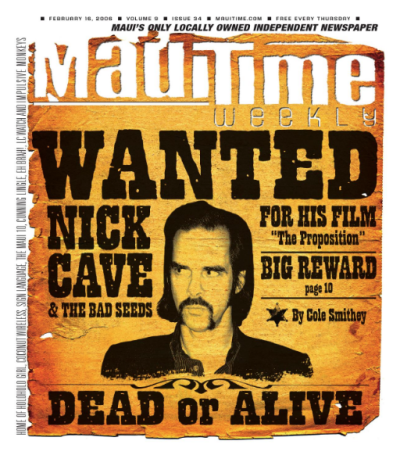 Since rattling London’s post-punk rock scene in the early ‘80s with his band "The Birthday Party," and reinventing himself with "The Bad Seeds" in the mid-‘80s, Australian-born singer/songwriter Nick Cave has staked out a solid niche as a renaissance hero of goth music and violent deadpan imagery. In 1983 Cave co-wrote his first screenplay "Ghosts … Of The Civil Dead" in which he starred as an insane prisoner under the direction of music video director John Hillcoat.
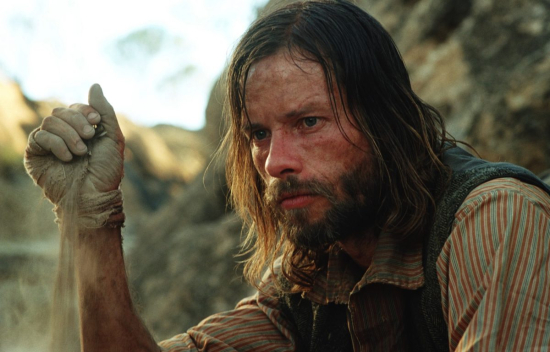
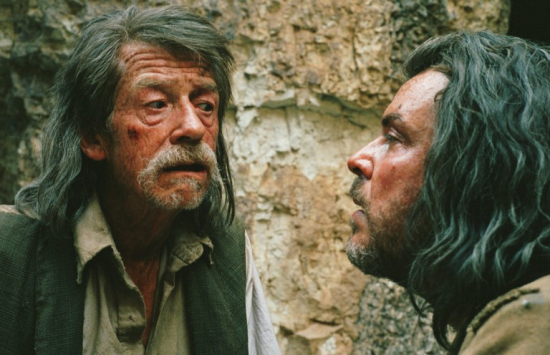
Now Nick Cave has returned to screenwriting with a melodramatic post modern western titled "The Proposition." Set in the Outback of 1880s Australia, the John Hillcoat directed story involves two diametrically different outlaw brothers who are pitted against one another by Captain Stanley (Ray Winstone) a local law enforcer threatening to execute their younger brother unless Charlie (Guy Pierce) murders his brother Arthur (Danny Houston). Although Cave does not appear in the movie he composed the film's ethereal soundtrack with his longtime Bad Seeds collaborator Warren Ellis.
In the cold of mid-January Manhattan I sat down with Mr. Cave at the Regency Hotel on Park Avenue to find out more about the significance of "The Proposition."
CS: Was this story based on any real events?
NC: No, it was all fake.
CS: How did you come to write the script for John Hillcoat?
NC: I’ve known him for about 20 years, and for about 18 of them he’s been talking about the Australian western he’s going to make and that I would do the music. I’ve continued to work with him through that 18 years and eventually he commissioned a script, that got written, which was basically an American western kind of dumped in Australia and we both thought that that was not the sort of thing he wanted to do. And then he went, "Well fuck it, you write it then." So, I did.
I wrote it very quickly; it took three weeks to write because I refused to invest anymore time in something that I basically knew would never ever get made. After a couple of difficult years he actually got it made.
CS: How did the conventions of American westerns influence you in writing the script?
NC: I think John’s heavily influenced by the anti-westerns and revisionist westerns of the ‘70s – "McCabe & Mrs. Miller" and Peckinpah’s stuff. But I think we felt that the average Australian had a different view of their history than the average American. I don’t think we see things so much in black and white, or good guys and bad guys, or villains and heroes. We have a much more conflicting, ambiguous shame-faced view of our history. I think we basically see it as a history of failure and incompetence.
CS: What’s the source of that shame?
NC: If you look at a lot of stories like Ned Kelly and stuff like that; the antics they got up to are hilarious and foolish, and you see how kind of doomed they are. And so, our heroes are murky characters. So, we wanted to write a story where you go to a film and expect your radar to focus on who’s the one to sympathize with and who’s the one you want to see get their comeuppance at the end. This radar is confused throughout and sometimes you feel aligned to one character and then you shift your allegiance to somebody else, and that in the end they are a group of people in a place that they should never be and they’re being slowly dismantled by their own folly.
CS: Were you developing or writing any of the music that you composed for "The Proposition" while you were writing the script?
NC: Yeah, the script has all of the musical cues in it. You know, into the violins and all of that sort of stuff. So, I was writing that as I was writing the script. I think the script is kind of musical.

CS: You have a double DVD that’s just coming out "Nick Cave And The Bad Seeds – Road To God Knows Where / Live At The Paradiso." Have you looked at them?
NC: No, I never look over my stuff. It just puts me off my game. I’d rather live in a kind of fantasy world that what I do is brilliant, and I don’t really ever want to kind of actually see it for what maybe it really is. So I never listen to my music, I never watch myself on TV or, especially, footage of myself live.
CS: There is a lot of violent imagery in the movie, and anyone who knows your music would probably be familiar with it, so it wouldn’t be that shocking. How did John influence the violent tone of the movie?
NC: John is very interested in violence. If you see his first and second films, he is certainly interested in the aftermath of violence and where violence takes you. I guess when John does violence he does it fast and brutal and it’s ugly and out of the way. Then he deals with the ramifications of that. That’s what he’s primarily interested in. People talk about this film being a violent film, which I find slightly irritating because the stuff that comes out of Hollywood are great ballets of violence. [Hollywood] scripts are being written for the express purpose of just having a whole lot of violence like Tarantino films which I find pretty unwatchable most of the time. So when John deals with violence, I think he deals with it in a realistic way and that it’s a fundamental part of the story. It was a violent time and a violent so-called ‘civilizing’ of the country.
CS: You’ve written your scripts pretty quickly, but your music takes much longer. What is the difference four you between those two things?
NC: To write a song and see it through to the end is really hard work. It’s not building a house or bricklaying or anything like that, but for me it’s a very difficult process and the hardest part of it is when you’re trying to start off a song. I’m sitting alone in my office and I’m trying to think about what I want to write about, and all I am is sort of exhausted by my own tiresome kind of opinions about things, and all of this bullshit that I’ve got in my head. It’s very difficult to get through that and actually call together some kind of a song. Whereas when I’m writing a script, when someone says write an Australian western, you don’t have to worry about how you feel about anything, or your own ideas about anything. You just sit there and get a few characters; the story has its legs.
CS: Are you planning on writing more novels?
NC: No. I think once you’ve written a couple of film scripts, you can never write a novel again. I just never had any desire to write another one. Writing one in the first place was just a sort of perverse idea at the time. I don’t have any ambitions to be an author, really. For me, I just really want to be a songwriter and that’s what I’m primarily interested in.
Get cool rewards when you click on the button to pledge your support through Patreon. Thanks a bunch pal!