Brothers of the Rope
George Mallory’s Quest is Brought Full-Circle
By Cole Smithey
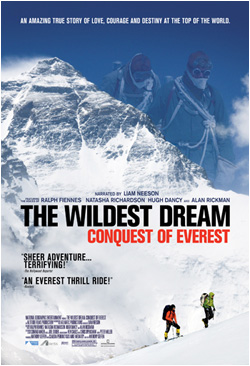 Just when you were fed up the whole idea of people climbing Mount Everest like it was a rollercoaster at Magic Mountain, documentarian Anthony Geffen reclaims a significant aspect of the mountain’s storied history. The 1999 discovery of British explorer George Mallory’s frozen body in Everest’s famous “Death Zone” by American mountaineer Conrad Anker, lays down the parameters for a biographical essay on Mallory and the love his life, his wife Ruth, whose photo Mallory promised to leave on the mountain’s peak. Mallory’s heartfelt letters to Ruth during their time apart provide a contained spectrum of his poetically expressed romanticism undaunted by the aspiration that consumes him. Amazing archive film footage from Mallory’s 1924 expedition, cherished photo stills, and a roundelay of gifted narrators that includes Liam Neeson, Ralph Fiennes, Hugh Dancy, and Natasha Richardson combine to create a time-flipping effect to the viewer in touch with the momentous breadth of its subject.
For his attempt to climb Everest in 1924, the 38-year-old Mallory chose as his climbing partner 21-year-old Sandy Irvine for the younger man’s strong physicality as an Oxford oarsman and for his technical ability with oxygen tanks. Neither men would survive the climb, and the question of whether or not they were the first men to summit Everest is one of the central issues the film addresses in an unvarnished way.
In 2007, 83-years after Mallory’s doomed expedition, Conrad Anker and his co-climber Leo Houlding attempt to climb Everest during the exact same late season May/June time period that Mallory and Irvine did. They take with them gabardine jackets and hobnail boots identical to the ones that Mallory used, to test the clothing’s practicality for such a rigorous journey. A particularly spectacular aspect of their mission to recreate Mallory’s climb involves removing the aluminum ladder that a group of Chinese climbers installed in 1975 in the Death Zone, to take a crack at free-climbing Everest’s “Second Step,” just as Mallory and Irvine would have had to do in 1924.
Never for a second is there any doubt that the prime motivation of the film is to assess the probability that George Mallory and Sandy Irvine were indeed the first men to make it onto the peak of Mount Everest. The photo of Ruth that Mallory promised to deposit at the mountain’s top was not with his corpse, while other possessions like letters, an altimeter, and a watch were still with him. George Mallory will likely best be remembered for his response to a New York journalist who asked him, “Why climb Everest?” Mallory’s iconic reply, “Because it’s there,” is an enigmatic concept that the film eloquently embraces, and illuminates on a visceral and intellectual level.
It’s a shame that Mount Everest has turned into an amusement park for rich poseurs with barely an idea of who George Mallory was or what he was about as a man. It would be great if the filmmakers didn’t put the Chinese ladder back on the Second Step.
Rated PG. 93 mins. (B+) (Four Stars – out of five/no halves)